

How many incident reports have your team written this year? Now, the more difficult question: how many of those reports were genuinely read at all by those who needed them most?
If the first question makes you wince a little, you're in good company. It's one of the quietest open secrets in safety. We are very good at documenting incidents and not nearly as good at making sure the people who need to learn from them, do.
The report gets written. The lesson doesn't get learned.
Historically after a serious incident, communications are shared within a few days. A one-page alert, a slide, a stand-up at the start of shift. People nod, someone signs the sheet, the work continues. Eight months later, on a different site in a different country, something close to the same thing happens again.
If you've spent any time in safety, you've seen this loop play out many times before. It isn't because people don't care, and it isn't because the alert was badly written. It's because telling people about a lesson and that lesson actually landing are not the same thing.
There are two reasons these lessons don’t land.
The first is that incidents don't happen because someone forgot the contents of a slide. They happen in the middle of real work, with conditions changing, with a contractor handover underway, pressure to keep moving and a document written months ago that doesn't quite match what's in front of you. A report asks the reader to remember a conclusion someone else reached long before.
But the original failure was a judgment call under pressure, and passively reading about it afterwards doesn't strengthen the next person's judgment.
The second reason is harder to talk about. Most incident communications, even the well-meaning ones, carry a quiet undertone of blame. The worker failed to isolate. The supervisor didn't check. The moment that tone shows up, learning shuts down. People distance themselves from the person involved ("I'd never do that"), and the instant they do, they've decided the incident report has nothing left to teach them.
Why the "who" question is costing you the lesson
There's a reason the same incidents keep happening across different sites, different teams, different years. Blame lets everyone decide the incident belongs to someone else.
A growing number of safety teams are already making this shift towards Human and Organizational Performance, or HOP. The premise is simple and slightly uncomfortable: people don't come to work to get hurt. In almost every incident, the choices made sense to the people making them based on what they knew at the time and the conditions they were in. The useful question isn't who messed up. It's why this made sense at the time, and what systemic failures allowed it to happen.
Understanding this is what changes decision-making in the field. And it's the principle that Pixaera’s Learning From Incidents (LFI) is built on.
"That could have been me" is the most useful sentence in safety learning. You only earn it by taking blame out of the room and putting the learner inside the decision.
Pixaera transforms your incident report into a lesson that actually lands
A few minutes walking through the sequence of events, one decision at a time, being asked what they would do, and seeing where each choice leads. That’s where real value can be found and what ultimately changes the status quo.
This is where Pixaera’s Learning From Incidents (LFI) comes in.
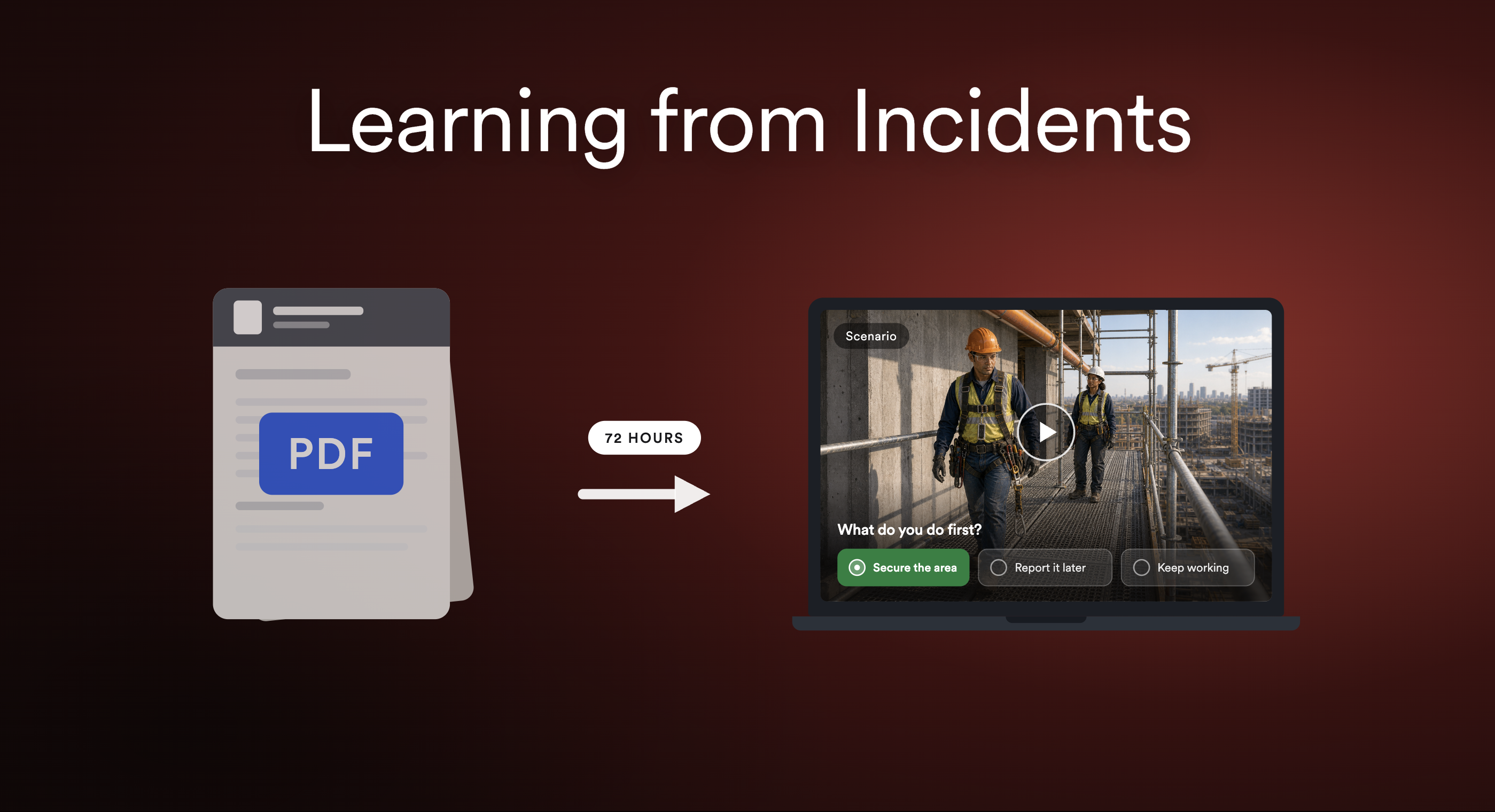
LFI takes one real incident, either one of your own or an anonymised near-miss from your sector, and turns it into an experience for your workforce to step through, moment by moment. It’s a short, interactive scenario built from the incident itself which enables workers to navigate how the incident unfolded, face the consequences, and do it with no blame attached to the colleague involved.
It’s something your crews engage with rather than passively skim, and the framing stays HOP the whole way: not who failed, but why each step made sense, and which control would have changed the outcome. It ends on the control, not a verdict.
You hand over an incident report you've already written, and within two working days you have an interactive scenario ready to be shared. You sign off the script and Pixaera handles the build.
From there it behaves like any other module on the platform you already run. Completion and score data are built in, so you can see who has been through it and how well the lesson is landing. Distribution is a few clicks rather than a rollout project: send it to one crew or push it across every site at once, in the languages your workforce speaks.
So the report that used to be filed and forgotten becomes something your whole organisation can learn from this week, and for once you can tell whether it worked.
This is a shift worth making
The bar has quietly moved. For years the focus was on whether everyone completed the training. The serious teams now ask a harder question: when it counts, will people make the right call?
Which brings us back to the original question. The incident reports will keep coming. The real choice is what each one becomes: another report filed and forgotten, or something your workforce genuinely learns from, quickly enough to matter and honestly enough that it sinks in.
Every incident report in your archive is a lesson your workforce hasn't learned yet. We want to change that. Share an incident with us and we'll build it into a Learning From Incidents module within two working days, and you'll see exactly how it works on your own real event.
